Historical text by Gilles Ouellet, c.j.m. The announcements and functions mentioned correspond to the context of its publication.
Tribute from the Eudist Province of North America and the Philippines to the Mother Church of Quebec
During the next meeting of the General Council of the Congregation of Eudists, from November 8 to 17, the Community of priests of the Seminary of Quebec, founded by Saint François de Laval, will receive in residence the Eudists who are members of this Council.
This is a unique opportunity for us to recall the ties that united Saint François de Laval and Saint Jean Eudes from the time of their presence in the city of Caen in Normandy until the arrival of the founders of the Church in New France.
At different times, two of the community's recognized historians wanted to raise awareness among Quebec and French readers of the networks of friendship existing between the Norman apostles and the young church of Canada.
Their documents, published in Eudist and Canadian journals, have become practically inaccessible. We like to send you an armful of memories carried in the memory of the elders of the Congregation.
The Father Charles Lebrun – editor of the Complete Works of Jean Eudes and residing at the Seminary of Rimouski at the time, published, at the time of preparations for the beatification, an article from May 1906 in the review New France.
For his part, Father Charles Du Chesnay, in an article in the journal Our Life, in May-June 1959, on the occasion of the tercentenary of the death of Jean de Bernières, also mentioned the links of François de Laval with the friends of Normandy.
What do they remind us of?
by Gilles Ouellet, c.j.m.
Gilles Ouellet was born in Sainte-Anne-de-la-Pocatière in 1942. He studied at the Séminaire Sacré-Cœur in Quebec and at the Séminaire Saint-Jean-Eudes in Pointe-Gatineau. He was incorporated into the Congregation of the Eudists on September 9, 1967 and ordained on December 30, 1967.
He taught at the Charlesbourg student residence, at the Saint-Jean-Eudes Séminaire in Pointe-Gatineau, at the Dominican College in Ottawa and at the University of Sherbrooke.
He was also pastor of the Bon-Pasteur Parish of Laval. Between 1976 and 1996, he was director of the Laval Ressourcement Center and provincial advisor. He was Provincial Councilor for many years - from 1983 to 2000 - and also Provincial Superior of the Eudists from 1983 to 1990.
Gilles Ouellet held numerous mandates as an administrator before being general director of Champboisé and General Treasurer from 2013 to 2019. Since 1997, he has offered numerous sermons at special events and retreats. Since 2019, he has been Provincial Superior of the Eudists of North America and the Philippines.
Biographical sketch reproduced in its historical context.
First, Father Duchesnay
It is probably between 1654 and 1658, during the stay of Mr. de Montigny in Caen (Saint François de Laval), that we must place the relations which were established between Mr. de Montigny and Father Eudes.
“Were they not both admirers of Marie des Vallées? Mr. de Laval, who had visited him several times and who had gone on pilgrimage to his tomb, brought to Canada and preserved with respect throughout his life some of his relics, which he had obtained. » Such is the testimony of La Tour, one of the first biographers.
He also reports another fact, which until now the biographers of Father Eudes seem to have neglected: during François de Laval's first crossing, he took with him two priests, known at the Hermitage of Caen. One of them, Mr. Jean Torcapel, was the first minister of the Quebec chapel. Falling ill during his first year of service, he returned to France.
Here is the information retained:
Torcapel left Quebec on October 18, 1660 (Henri de Bernières, nephew of Jean, succeeded him in the chapel of Quebec and became the first priest of this parish).(1)
Jean Torcapel, who had praised to Father Chaumonot, a Jesuit missionary, the ardent devotion that Father Eudes had for the Blessed Virgin, arrived in Caen carrying a letter from the pious Jesuit, written on October 14, 1660. But here is what we read in the Book which contains the names of those who are from the body of the Congregation of Jesus and Mary (register kept in Caen in the archives of Calvados): “Jean Torcapel, priest, of the parish of Vaucelles de Caen, received in Coutances at the age of 35, in 1666, died in Évreux, on September 19, 1668. The Obituary of Rouen (in the archives of the Eudists in Paris) adds: “After having been ill for more than a year with third, quarte and double quarte fevers. He is buried in our chapel in Évreux. » In other words, Mr. Torcapel was malarial. We knew that he had to leave Quebec for health reasons. Had he ever contracted malaria there?
Priest in turn to Mgr de Laval and Father Eudes, this forgotten Eudist, the first to have served in Canada, if he did not die on ordered service, at least appears as a generous soldier, victim of an illness “contracted in service”…
“La Tour, in its precious Memoirs, attaches great importance to the Hermitage of Caen. Several of the priests who served Mgr de Laval had frequented him: Henri de Bernières, Louis Ango des Maizerets, Thomas Morel, Jean Dudouyt (the brother of Jacques, the Eudist mentioned above). His servant also, Denis Roberge, the same one who had witnessed the last moments of Jean de Bernières.
Mr. de La Tour, former vicar general, writes: “As all those who since composed the seminary of Quebec had been trained at the school of Mr. de Bernières and carried into the new world the spirit they had adopted there, it is good to give here the spiritual maxims on which this holy man had established it. »
Photo: Fonds Daniel Abel - Detail of Monseigneur de Laval's monument, with Marie de l'Incarnation holding the child and Catherine de Saint-Augustin with the patient.
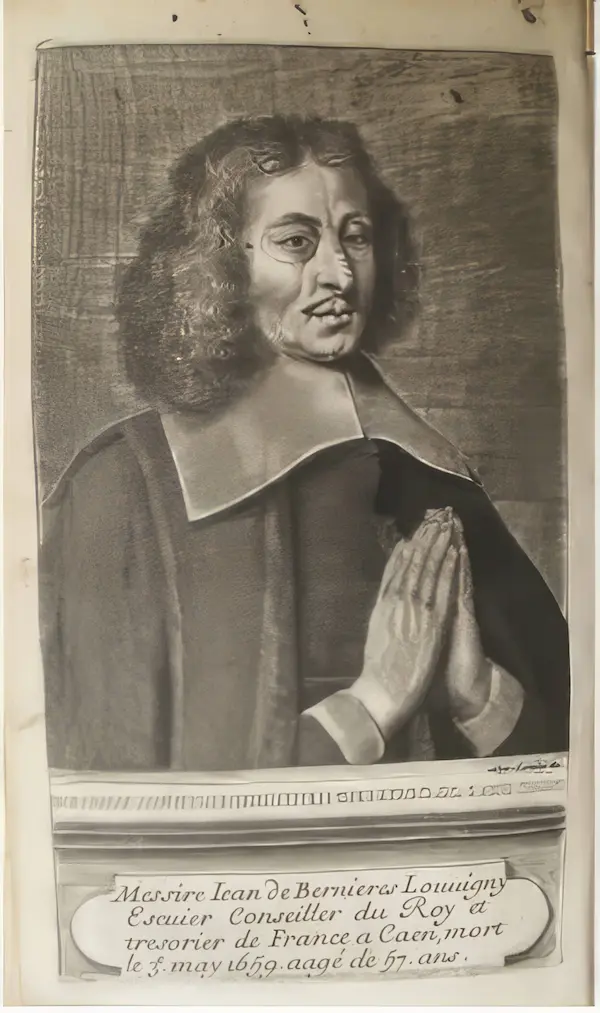
Jean de Bernières
In Father Lebrun's contribution we find:
It is in 1650 that we find the starting point of the relations of Mgr de Laval, who was then only the abbot of Montigny, with Father Eudes.
We know that at this time the society of Good Friends was formed in Paris under the direction of Father Bagot, a Jesuit, from which later emerged the beautiful work of the Foreign Missions. The members of this society were, with the abbot of Montigny, MM. Boudon, Pallu, Fermanel and Gauthier. However, under the influence of Mr. Boudon, this society adopted, from the beginning, the devotion of Father Eudes to the Holy Heart of Mary.
The year 1652 was marked in Paris by a revolt against Mazarin who held the reins of government as prime minister. During the troubles, Abbot de Montigny and several of his colleagues took temporary refuge in Argentan with Mr. Ango des Maizerets, where they continued their life of retirement and prayer. They made a pilgrimage together to the sanctuary of Notre-Dame-de-la-Délivrande which is located a short distance from Caen.
Passing through Caen. said M. de la Tour, we visited the famous Father Eudes; the holy founder received the pilgrims with distinction.... Hence comes the union which has always existed between the Eudists and the seminary of Foreign Missions.(2)
If this visit cemented the union of the two societies, we know that we have to go back further to find its origin.
Two years later, Abbot de Montigny retired to the Hermitage of Caen, where Jean de Bernières-Louvigny, former treasurer of France in the generality of Caen, brought together a few elite souls who wanted to practice, like him, the interior life and the practice of good works. The Hermitage house was located next to the Ursuline convent that Jourdaine de Bernières, sister of the general treasurer, had built, and of which she had become superior. This explains the dedication of Mr. de Bernières for the Ursulines of Quebec of which he was the providence with Madame de la Peltrie.
The Hermitage, in turn, became for the church of Quebec a nursery of apostles of unfailing virtue and zeal. We live there together with the abbot of Montigny, who spent four years there, MM. Ango des Maizerets, Dudouyt, Morel, Torcapel, Pèlerin and the founder's nephew, Henri de Bernières, who became the first companions and devoted auxiliaries of Mgr de Laval in Quebec.
Great souls understand each other and ally themselves. Jean de Bernières and Father Eudes lived in a close union. On various occasions, Mr. de Bernières rendered important services to the nuns of Notre-Dame-de-Charité and was generous towards the seminaries of Father Eudes. He also helped pay for at least one of his missions.
What is certain is that at this time Father Eudes and Father de Montigny worked together and often spoke about the extraordinary life of Marie des Vallées. This virtuous girl once enjoyed a certain notoriety in Canada; but even more than that of Father Eudes, his memory has been erased over time. Here is his story in two words.
During a mission that he preached in Coutances in 1641, the venerable was invited to examine this pious girl, whose extraordinary life was then making a lot of noise. He did not take long to recognize the treasures of grace and virtue contained in this soul so pure and so tried by suffering, and he never ceased to thank God for having sent it to him:
In this year 1641, he wrote in his Memoriale beneficiorum Dei, in the month of August, God gave me one of the greatest favors that I have ever received from his infinite goodness; because it was at this time that I had the happiness of beginning to know Sister Marie des Vallées, through whom her divine Majesty gave me a large number of notable graces. After God, I owe this favor to the Most Holy Virgin Mary, my very honored Lady and my very dear Mother, for whom I will never be able to thank her enough.(4)
Bishop de Matignon having later asked him to take charge of the conduct of Sister Marie, he did so with joy, and to be better able to direct her and report on her condition to his superiors, he collected in a Memoir written for his personal use what this pious girl had made known to him about her life and her dispositions. It is this manuscript, now lost, that has been called the Life of Marie des Vallées.
Marie des Vallées was well known at the Hermitage of Caen. Mr. de Bernières was in a relationship of piety with her. Instead, read what Mr. de la Tour says about it in his Memoirs on the life of Mgr de Laval:
M. de Bernières-Louvigny, he writes, died on May 8, 1659. This holy man had been warned three years previously by Sister Marie de Coutances for whom he had, like everyone else, a singular veneration. This holy girl, some time before her death (1656), discovered the most secret things to him and announced his death to him under the idea of a chalice which sweetened it for him, and recommended to him the Hermitage of Caen, calling it the garden, where like the Bridegroom of the canticles, God preserved his fruits.(5)
Mgr de Laval also brought to Quebec a copy of the Life of Marie des Vallées composed by Father Eudes. Mr. de la Tour does not say it; but the memory of this fact was preserved in the Congregation of Jesus and Mary. Mgr de Laval, says Father Ory, “had to receive as a present a copy of the Life of Marie des Vallées. It is therefore in Canada that there is the greatest chance of finding this work” (6).
Research carried out recently at the Laval University library led to the discovery of this precious copy which was graciously returned to R. P. Le Doré, superior general of the Eudists.
It was in April 1659 that Mgr de Laval, consecrated the previous December 8 as titular bishop of Petraea and vicar apostolic of New France, embarked from La Rochelle for Canada. He took with him, in addition to Father Lallement, a Jesuit, and Mr. de Lauzon-Charny, MM. Torcapel, Pèlerin and Henri de Bernières. All three came, like him, from the Hermitage of Caen.
Father Eudes played a large part in this return to the past. We find proof of this in a letter from Father Chaumonot to the Venerable which he entrusted to Mr. Torcapel, when, after a year, this generous priest was obliged, like Mr. Pèlerin, to return to France.
Born far from Normandy and taken early to Italy by his adventurous mood, Father Chaumonot certainly did not know Father Eudes before coming to Canada. It is in the entourage of Mgr de Laval, and also perhaps among the Augustines of the Hôtel-Dieu, whom he heard speak of his virtues and his extraordinary devotion to the Blessed Virgin. Here is the letter that Mr. Torcapel gave on his behalf to Father Eudes. It does too much honor to its author, and, on the other hand, it shows too clearly the singular esteem then enjoyed in New France by the founder of the Congregation of Jesus and Mary for us not to reproduce it in its entirety:
Letter from Father Chaumonot · October 14, 1660
Quebec, October 14, 1660.
My Reverend Father,
I was consoled to hear from Mr. Torcapel the holy ambition you have to surpass anyone in loving Our Lady. Would to God that you could communicate this spirit to all the ambitious people on earth! Would I dare ask you for the love of Mary, virgin mother, whom you love so much, to procure for me the advantage of being admitted, as the last of your servants, to the service of this sovereign mistress, or, if you prefer, as the least of your juniors, to the adoption of this mother of mercy.
MM. Torcapel and Pèlerin were replaced in Quebec by MM. Dudouyt and Morel, who came to join in 1663 Mr. Ango des Maizerets. All three had lived at the Hermitage in Caen: they were friends of Father Eudes. I do not believe that time and distance have weakened this friendship, at least as far as Mr. Dudouyt is concerned.
The biographers of Mgr de Laval tell us that Mr. Dudouyt had a brother who had also been the guest and disciple of Mr. de Bernières.
The Dudouyt brothers, known as Mr. Langevin, passing through Caen, went to visit Mr. de Bernières and formed the resolution to retire there with him. One of them, Jean, joined Mgr de Laval in Canada in 1662.(7)
Jean Dudouyt's brother was called Jacques. He is well known in the Congregation of Jesus and Mary. Here is his story:
Is it rash to think that the entry of Jacques Dudouyt into the Congregation of Father Eudes contributed to bringing the name of the Venerable more often to the lips of his brother and of the friends who had known him at the Hermitage of Caen?
The life of Marie des Vallées made too much noise at that time, especially in the diocese of Coutances, for Catherine de Saint-Augustin not to have heard about it before leaving France. In any case, the rest of her life will show us that in Quebec, as in France, the veneration of Sister Marie de Coutances accompanies the devotion to the Holy Heart of Mary of which she was the inspiration.
Mgr de Laval was therefore towards Catherine de Saint-Augustin what Father Eudes had been for Marie des Vallées. He knew and approved her devotion to the Holy Heart of Mary. He knew his mystical relationships with Sister Marie de Coutances whose life he had in his hands. How often his thoughts had to turn to his friend from Caen! How many times the names of Father Eudes and Marie des Vallées must have been mentioned in the frequent conversations he had with the pious hospitaller of the Hôtel-Dieu!
We know that Bishop Laval returned to France for the first time in 1662. During his stay in Paris, he gave new proof of his devotion to the Holy Heart of Mary by approving the book that Father Eudes had composed to spread it and which contained the office and the mass of February 8. This approval is little known in Canada.
After 1662, we no longer find any positive information on the reports of Mgr de Laval and Father Eudes. The distance made them rarer, without however diminishing the esteem that these two servants of God had for each other. Also when in 1681, a few months after the death of Father Eudes, his successor, M. Blouet de Camilly published the Venerable's book on the admirable Heart of the Mother of God, he wanted to offer a copy to Mgr de Laval who thanked him by the following letter dated November 12, 1682:
Letter from François de Laval · November 12, 1682
I received the book that you sent me, from the Heart of the Blessed Virgin, as a mark of your affection, and our seminary will have no greater joy than to see itself united with your Congregation, which is all about Jesus and Mary, whom we profess to honor under the title of the Holy Family, to whom we have dedicated our seminar. And as, by virtue of this union, you will participate in all the good that is done there, we expect from your Congregation the same grace, that you will not forget to pray for this nascent Church, which it has pleased Our Lord to entrust to us, so that it will always grow in its perfection. This is what I expect from you, assuring you that I am in Xto...
- FRANÇOIS, bishop of Quebec.
The spiritual union referred to in this letter was too consistent with the views of Father Eudes for his successor to be indifferent to it. Our Annals tell us that he took the necessary steps for it to be ratified by an authentic act, but this act, if it was signed, has not reached us(9).
However, devotion to the Holy Heart of Mary continued to progress at the Hôtel-Dieu in Quebec, and when, in 1690, the protection of Mary had delivered the city threatened by the fleet of Admiral Phips, the nuns requested and obtained from Mgr de Saint-Vallier the favor of celebrating each year, using the services of Father Eudes, a solemn feast in honor of this Holy Heart. Bishop Laval said he felt great joy, while, from heaven, we like to believe, Father Eudes, Marie des Vallées and Catherine de Saint-Augustin attended this celebration to the institution to which they had contributed so much.
We hope to have piqued your curiosity a little. We offer you in their entirety the two articles to which we have just referred.
Our contribution is intended to be a recognition of this first missionary bishop at the origin of the local Church, of all his valiant collaborators from the Hermitage of Caen, of these congregations of women who were the first to “go out for the mission abroad.
Notes and references
(1) Mr. Torcapel, who made the first trip with Mgr de Laval, was assigned, upon his arrival, to serve the chapel of the Immaculée-Conception. Historians of the Séminaire de Québec reserve the appellation of “parish priest” for Henri de Bernières, nephew of Jean de Bernières, at the time of the official establishment of the parish in 1664.
(2) De la Tour, Memoirs on the life of Mgr Laval, p. 31.
(3) Cf. Adam, Marie des Vallées, Paris, Poussielgue, 1894.
(4) Memorial beneficiorum Dei, ms., n. 33.
(5) Memoirs on the life of Mgr de Laval, p. 30.
(6) The Origins of Notre-Dame-de-Charité, p. 82.
(7) Biographical note on François de Laval, p. 263. Montreal 1874.
(8) The text of this letter of approval was published a few years ago, at our suggestion in the Bulletin of Historical Research.
(9) Annals of the Congregation of Jesus and Mary, t. 2, p. 20.
NOT TO BE MISSED
The death of M. de Bernières in Caen and the arrival of Mgr de Laval in Quebec in the spring of 1659
In 1959, in the eudist magazine Notre Vie (May-June, no. 69), Father Charles Du Chesnay, historian and archivist for the Province of France offers a armful of memories to friends of the province of Normandy and the province of Quebec. It seemed interesting to us to re-propose this documentation to you suggesting links to be explored in greater depth between Hermitage of Caen and the first bishop of Quebec.
François de Laval is the first bishop of Quebec. He founded the Seminary of Quebec and traveled immense territories by canoe, snowshoe or on foot to support the emerging community.
By Geneviève Riendeau · February 20, 2023 · myCommunity
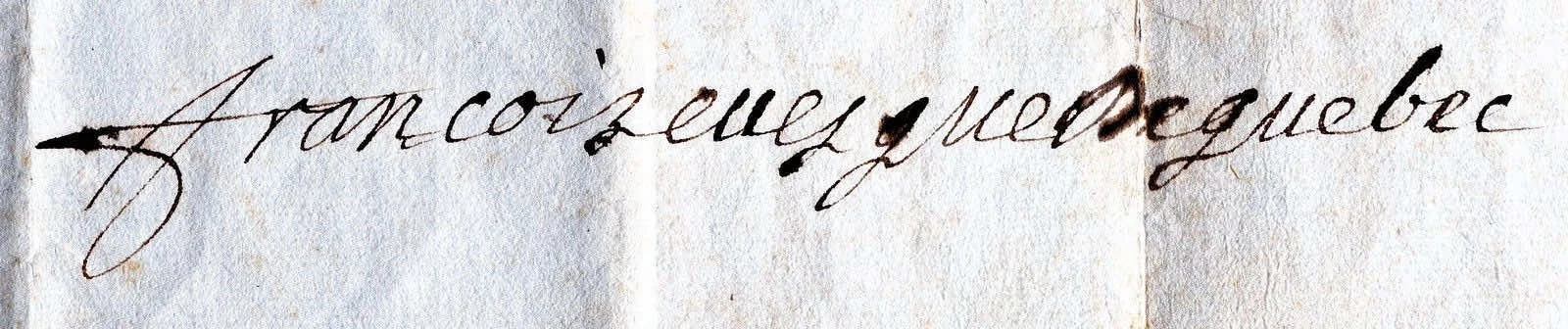
Photo: Daniel Abel Fund – Signature of Saint François de Laval