Icon of Saint John Eudes – Champboisé
The word “icon” is somewhat mysterious. It calls to mind a religious painting, a sacred work imbued with presence, and raises many questions.
An icon portrays the supernatural and holiness through painting. It is more than a picture: it is a prophecy in images, filled with a presence that looks at us and changes us. The icon silently shows what the Word proclaims and the liturgy celebrates. It brings us into relationship with its model:
History
The making of icons dates back to the early Christian era and reached its height in Byzantium more than a thousand years ago. This wooden depiction of Christ, Mary, and the saints is unfamiliar to us in the West. An icon is not explained; it is gradually discovered through faith and prayer. Today’s renewed interest in icons expresses a vital and urgent longing to return to the historical roots of salvation in Jesus, son of David, and to contemplate Christ in glory, risen and raising others to life. The icon is a sign of hope.
During a stay at Champboisé, I felt inspired to create an icon for the community gathering place. After several conversations and thanks to a fortunate combination of circumstances, the idea became a reality.
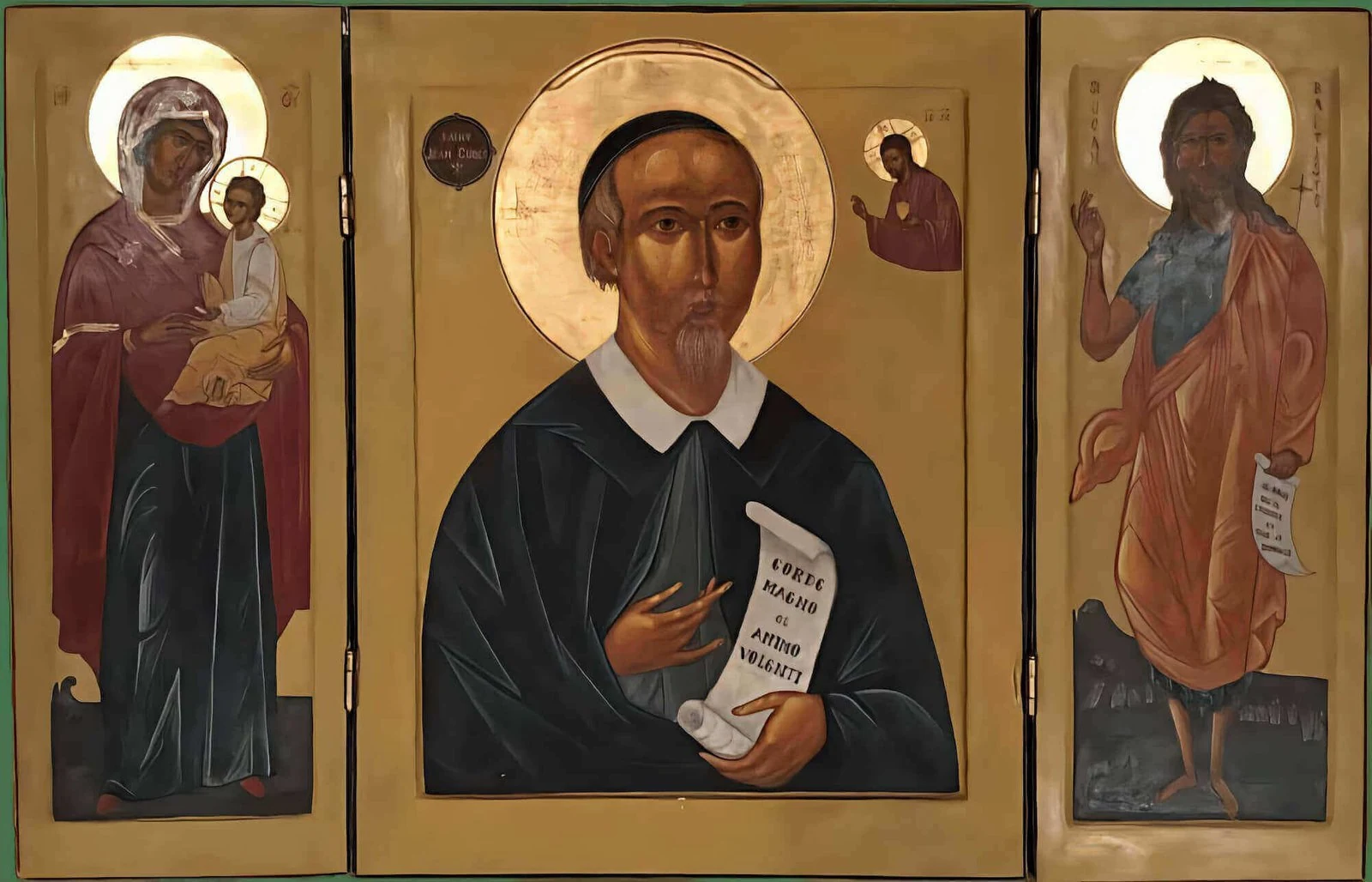
The triptych consists of three panels and depicts the following (when viewed from the front):
· On the right, John the Baptist, known as the apostle of the desert. What could be more fitting for a place of solitude?
· On the left, Mary holding the child, known as the “Guide.” In iconographic form, she recalls John Eudes’s devotion to the holy Hearts of Jesus and Mary, as well as the name of the Eudist Congregation.
· In the centre, Saint John Eudes. Only the central panel is discussed here.
JOHN EUDES appears from the waist up, quietly commanding attention through his welcoming, fatherly manner.
His youthful face, marked by gentle serenity and deep peace, invites us to share in his inner life and love. His tender yet resolute gaze seems to open paths to commitment and mission.
His right hand points to the heart, the home of love. This reflects the devotion John Eudes encouraged and practised: “He has always carried me in his arms, even in his bosom and in his heart, with more care and love than a mother carries her child.”
In his left hand, he holds a scroll bearing the motto: “CORDE MAGNO ET ANIMO VOLENTI” (“With a great heart and a willing spirit”).
John Eudes wears a blue-green mantle, a symbol of life: green evokes nature and vegetation, while blue evokes divine life. Everything points to growth and fruitfulness.
Christ appears on the right, conferring the priesthood on John Eudes. With his left hand he offers him the chalice; with his right, he blesses him.
Iconographic technique
The panels were prepared using the ancient Byzantine technique.
The central panel, made from a pine tree at Champboisé, was first covered with a fine linen cloth. It was then coated with hide glue and eight to ten layers of alabaster. Once dry and sanded, the panel was ready for the design, engraved with a drypoint tool.
In technical language, gold is called “light.” It is the first material applied to the design, illuminating the whole composition. The halo is a distinctive expression of this radiance.
Next come the layers of colour, made with natural pigments from the various countries where John Eudes carried out his missions.
The powdered pigments are mixed with egg yolk and water. It is worth noting that all three realms are represented: animal, plant, and mineral.
The work is built up in successive layers, gradually moving toward the light. There are no cast shadows: the light comes from within, from the very depth of a body grafted onto that of Christ.
Once the work is complete and the icon is dry, an olifa varnish made from linseed oil and a drying agent is applied. It unifies the layers and gives icons their characteristic depth and coherence.
A final varnish protects the icon from the ravages of time.
Conclusion
Beyond these explanations and reflections on the icon lies the space of mystery, prayer, the human relationship with God, and the unceasing search for happiness. The icon already opens a way toward this absolute, for God’s greater glory.
Panel 1 of the Champboisé triptych of the icon of Saint John Eudes.
Icon painted by: Ms. Céline Boucher, Sainte-Foy, Quebec, 1990.
Icon painted in Sainte-Foy, 1989–1990
Icon of Mary, Mother of God
This icon recalls John Eudes’s devotion to the holy Hearts of Jesus and Mary. It also recalls the name of the Congregation of Jesus and Mary.
This type of icon, in which Mary presents her Son, is called “Hodegetria,” or “She who shows the way.” The whole Gospel inhabits the icon in its human and divine dimensions: in the purity of its lines, the freedom of its movement, the openness of its gestures and gaze, and the figures’ stillness and motion. Their profound unity offers a rich mystery that surrounds and enlightens us in contemplation.
Although the icon bears the title “Mother of God,” Mary does not occupy the foremost place in the composition: the central figure is Jesus, whom she holds in her arms. The brilliant white of the child’s robe is considered a divine colour—the dazzling white of the Transfiguration: “His clothes became dazzling white.” Jesus is draped in gold to affirm his divinity.
His right hand rests on Mary’s chest, showing that he blesses through her heart; the position of his fingers also recalls the two natures of the incarnate Word. In his left hand, he holds a scroll containing God’s will for him.
Mary embodies tenderness and watchfulness toward her Son. The pure blue around her face is like the radiant sky. Her deep-blue tunic expresses her humanity, while her imperial purple mantle recalls her title as Mother of God and her intercession with her Son.
The three stars evoke Mary’s virginal motherhood and affirm that she is the tabernacle, the living temple of the Holy Trinity. God’s special favour places Mary in heaven, yet she is also fully present in our world, guiding us patiently to her Son.
The Virgin’s halo merges with her Son’s, reminding us that her holiness comes from him. The three Greek letters C W N in the child’s halo express God’s eternity: “I am who I am.” Above, the title “Mother of God” appears, while the letters I C X C identify Jesus as Son of God and Saviour.
Here the position of Mother and Son clearly emphasizes Mary’s role as mediator in relation to Christ.
It is a wonder to contemplate this union of Mother and Son in the mystery of salvation.
As Mary presents her Son to us, she turns her gaze outward, wishing to embrace all people with a look that is infinitely sorrowful at the Passion she foresees, yet infinitely tender and pleading for those who refuse her Son’s love.
The child is already the adult who walks toward his Passion, yet his face is full of compassion.
Mary strongly invites us to surrender ourselves to God’s mercy. She is attentive to each one of us and can open the door of our hearts to let her divine Son enter.
Together with the icon of Saint John Eudes, these two icons are intended to inspire prayer and draw grace upon all who look at them.
The Heart of Jesus, the Heart of Mary, the Heart of the Church, and the heart of each believer are one in the same mystery of prayer and love.
Panel 2 of the Champboisé triptych of the icon of Saint John Eudes.
Icon painted by: Ms. Céline Boucher, Sainte-Foy, Quebec, 1990.
Icon of Saint John the Baptist
Perhaps the most frequently depicted and most powerful ascetic image in all Russian religious painting is that of John the Baptist.
Three themes may be considered here: John as Christ’s forerunner, preacher, and prophet. As forerunner, he embodies renunciation of the world. He prepares humanity for a new understanding of life by preaching repentance, fasting, and every form of abstinence. His emaciated face and unnaturally thin arms and legs express this idea. From the exhaustion of his flesh, he draws strength to reach toward spiritual joy.
At the beginning of monasticism, John the Baptist was regarded as the superior of monks and nuns. Today, many consider him the patron of hermitages, as suggested by the animal-skin garment worn by hermits that clothes him.
John the Baptist is shown at full length. The golden-yellow garment over his shoulders expresses his sharing in God’s life. The blue of his animal-skin cloak matches Mary’s robe. Both bear witness to the Word. In his left hand he holds the cross, the foundation of his witness as a martyr. The scroll bears these words, which call to mind another saying: “A person can receive only what is given from heaven” (John 3:27–30).
The inscription
Saint John the Baptist has a ministry of witness: he bears witness to Christ’s submission, to his ultimate kenosis, or self-emptying. Yet, as an archetype and representative of humanity, John the Baptist stands for all humanity as witness to divine love. The “philanthropy of God” reaches its culmination in the act of baptism, the “fulfilment of righteousness,” and ultimately in death and resurrection—the fulfilment of the eternal plan we can contemplate in the icon of the Trinity.
“As all the people were being baptized, Jesus was baptized too” (Luke 3:21). The Word comes to earth, toward humankind. We are witnessing the most astounding encounter between God and humanity (“all the people”). In a mystical sense, all people recognize themselves in John the Baptist as “children in the Son,” “beloved children” in the “beloved Son,” and thus as “friends of the Bridegroom” and witnesses. The Virgin’s fiat was the yes of all humanity to the Incarnation, to God’s coming among his own. In Saint John, this other one who belongs to God, all people say yes to encounter, divine friendship, and the philanthropy of the Father, the friend of humankind. As Simeon, “moved by the Spirit,” meets and receives the child Jesus, so John meets and receives Jesus the Messiah: “There was a man sent from God whose name was John. He came as a witness to testify to the light, so that all might believe through him” (John 1:6–7). He
testifies for everyone, on everyone’s behalf; this witness is an event within all humanity and concerns every person.
The Fourth Gospel speaks of John in its prologue, immediately after “the Word who was in the beginning.” When we read “there was a man sent from God,” we sense that his coming, in a way, also comes from the “beginning,” from eternity. The heavens open before him and “he bears witness: I saw the Spirit descend upon him … He is the Son of God” (John 1:29–34). In this brief statement, the whole Gospel is already present in miniature. John knows; he points to the Lamb, for he has been initiated into the mystery of “the Lamb slain from the foundation of the world” …
John predicted nothing, yet he is the greatest of prophets: like God’s finger, he points to Christ. He is greatest because he is least, freed from self-sufficiency so that he is simply the one who “stands there,” rejoicing to hear the Bridegroom’s voice. As the Bridegroom’s friend, his joy is immeasurable. This is the closest intimacy in which the Word resounds. He is in the image of the Spirit because “he speaks nothing of himself, but speaks in the name of the One who has come. He is the one who violently seizes heaven.” His martyrdom beautifully illustrates an ancient monastic saying: “Shed your blood and receive the Spirit.” Together with the “Theotokos,” he surrounds Christ the Judge and intercedes for all humanity.
The liturgy calls John “preacher, angel, and apostle.” He bears witness, and his voice as the Bridegroom’s friend gives rise to the first apostolic vocation: “Andrew and John follow Jesus” (1:37). Later, he leaves this world and descends to the dead as a forerunner of the Good News.
Other liturgical texts: John 3:22–36.
Iconographic technique: the panel was prepared using ancient Byzantine techniques.
· Quebec pine.
· Linen cloth (an old altar cloth).
· Rabbit-skin glue.
· Eight to ten layers of sanded alabaster.
Drypoint engraving.
Colours: The halo is made with 18-karat gold leaf, applied using the polished-gold technique. Natural pigments from Europe are bound with egg yolk.
Finish: Olifa, a linseed-oil varnish, protects and unifies the layers of paint, giving them their characteristic harmony of depth and light.
Acrylic varnish.
Inscription: the inscription gives the image its full spiritual dimension and sacred character.
Bibliography:
· Paul Evdokimov, The Art of the Icon
· Eugène Eroubetzkoi, Three Studies on the Icon
Panel 3 of the Champboisé triptych of the icon of Saint John Eudes.
Icon painted by: Ms. Céline Boucher, Sainte-Foy, Quebec, 1990.