Congregation of Jesus and Mary · Since 1643
Prayer of the 19thCJM News
EN — Choose a language
← Napoléon-Alexandre Labrie

Betsiamites · 1923–1929 · A missionary’s reminiscences

Bishop Labrie in Betsiamites

Bishop Napoléon-Alexandre Labrie recounts his time in Betsiamites, the people who left a mark on him, and community life along the North Shore.

These excerpts are taken fromQuelques souvenirs (1905–1931), edited by Pierre Frenette. They are read by Father Jean-Guy Lachance, c.j.m., who was ordained by Bishop Labrie.

Explore the excerpts ↓

A missionary’s reminiscences

A parish, a territory, and its people

In his memoirs, Bishop Labrie recalls the beginning of his ministry in Betsiamites, hunting and trapping, the mission’s institutions, and journeys between North Shore communities. These accounts are presented as historical documents, with their original context and wording.

Read by Father Jean-Guy Lachance.Born in Québec City, he completed his classical studies at Externat St-Jean-Eudes and was ordained an Eudist priest by Bishop Labrie. He taught at Eudist colleges in Bathurst and Edmundston, then continued his philosophy studies in Rome. After returning to Canada, he taught for nearly thirty years at the college and in the Diocese of Edmundston. Here, he lends his voice to the bishop who ordained him.

Text source: Labrie, N.-A.,Quelques souvenirs (1905–1931), edited by Pierre Frenette. © Société historique de la Côte-Nord. Reproduced with permission.

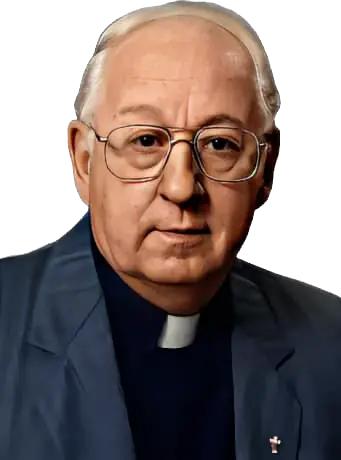
Portrait of Bishop Napoléon-Alexandre Labrie

01

Pages 64–68

Father Labrie takes up his parish

His arrival in Betsiamites, learning the language, and the first months of his ministry.

Listen · Read by Father Jean-Guy Lachance

Read the text: Father Labrie takes up his parish

In the first days of September, I made my way to Betsiamites by the same route as before: Godbout–Matane, Matane–Rimouski, Rimouski–Betsiamites. A local merchant, Mr. Côté, operated a small motor schooner, the Miller, which carried mail and passengers…

Read more

between the settlements.

Father Jauffret, whom I was to replace, welcomed me with genuine fraternal kindness. The reception elsewhere, however, was far from enthusiastic. At the rectory I found my housekeeper, Mrs. Norbert Lebel, whom I had known as a child, along with her niece and grandson, Joseph Blouin, and Father Doucet’s brother, Edmond. The last two looked after our farm.

I had been told to arrive before Father Doucet returned from vacation. But when he came back, Father Jauffret had already left, and the curate, who had held the position for three years and learned the Montagnais language, frankly told me that he would have been better suited to take my place. I could only agree with him. Everything, however, had been decided against my wishes and arranged by Father Lebrun, who was not by nature the kind of superior one could talk things through with, as people expect today. What I had wanted was a year free to devote entirely to studying the language. I greatly appreciated my confrère’s honesty, and, fortunately, his deep priestly charity enabled a friendship to grow between us that never wavered.

Apart from the Miller family, who had long been friends of my own, the leading people in the village kept me at a chilly distance. I realized that being a local boy proved the saying: “A prophet is not without honor except in his own country.”

The Innu blamed me for Father Jauffret’s departure, even though he had rightly earned their trust and friendship. What could I do in such a situation? Wait, hoping that patience and forbearance would overcome their reserve.

I did receive some encouragement. One evening an Innu man, Étienne Adlé, a Mi’kmaq, came into my office. “Don’t worry if the Indians don’t like you,” he told me. “Leave it to me. I know you, and I know your father and mother. I know the Indians too. I’ll bring them around. You’ll see!” He spoke with great warmth, and as he was leaving he asked to borrow five dollars. How could I refuse such a kindly request? A fortnight later he brought me six dollars, with an even warmer speech and a request for ten dollars, which I lent him. Another fortnight passed; he returned with twelve dollars and an eloquent speech that ended with a request for fifty! By then, though, I had got to know this industrious gentleman and realized how much he owed the church. With what must have seemed appalling ingratitude, I gave him an unequivocal refusal.

In the meantime, things had changed completely for the better.

I had two outstanding teachers as I studied the language: Mr. Georges Rock (Ashini in Innu) and Mrs. McTavish, better known by her maiden name, Marie Picard. From a young age, Mr. Rock had served as an interpreter and church cantor. He had married Miss Collin of Mingan, who had come to work as a housekeeper for the Hudson’s Bay Company manager. They had four sons—Sylvestre, Georges, Paul, and Joseph—and the first three were remarkably bright. Paul served for many years as chief of the reserve. His three daughters were also exceptional, each with admirable qualities. By the time I arrived in Betsiamites, Mr. Rock was already elderly, yet he retained a quick mind and a gracious helpfulness that one could never forget. After Mass on major feast days, following an old custom, he would bring me his cantors. We served them a glass of wine. If I forgot to refill their glasses, Mr. Rock would limp away, and we had to bring him back to cure his lameness.

Marie Picard was descended from Charles Picard, a Huron from Lorette who had settled in Betsiamites. She was exceptionally intelligent. She spoke French with perfect grammar and pronunciation. Montagnais, a beautiful language, sounded like music in her mouth. Her ever-active imagination had no hesitation in embellishing events recalled by her remarkable memory. I regret not having written down more of what I learned from these two people.

The winter of 1923–24 was spent learning the language and getting to know my parish and its outlying communities. In the summer, Father Doucet left to serve the other Innu reserves along the Coast. I believe I had won back everyone’s goodwill.

One of my predecessors, Father Brière, had replaced Father Arnaud’s old church with a new brick church in 1914, I believe. It was beautiful and spacious, but its interior had never been finished. Bishop Leventoux came for a pastoral visit and to preside at the August 15, 1924 celebration. The Innu Council spoke on behalf of everyone, asking him for permission to complete the church, which had no outstanding debt. Permission was granted, and my inexperience had to rise to the task. I knew a skilled foreman, Mr. Thimothée Landry of St-Octave-de-Métis, and brought him in. He recommended an architect, his cousin Pierre Raymond, who prepared an excellent plan at modest cost with his partner, Mr. Dionne.

There were no carpenters in the community, so we had to bring them in from elsewhere, and lodging in Betsiamites was scarce. The rectory was large, so we put them up there. By the end of November, the materials were on site and the workers had begun. The work advanced steadily through the winter. In June, when our hunters returned from the woods, we were able to show them a finished church: all white and fresh beneath its beautiful coat of paint, with a polished floor and varnished pews. They could express their admiration only with the same words: “Miam waskut”—“It is like heaven!” They loved the church and took great care of it.
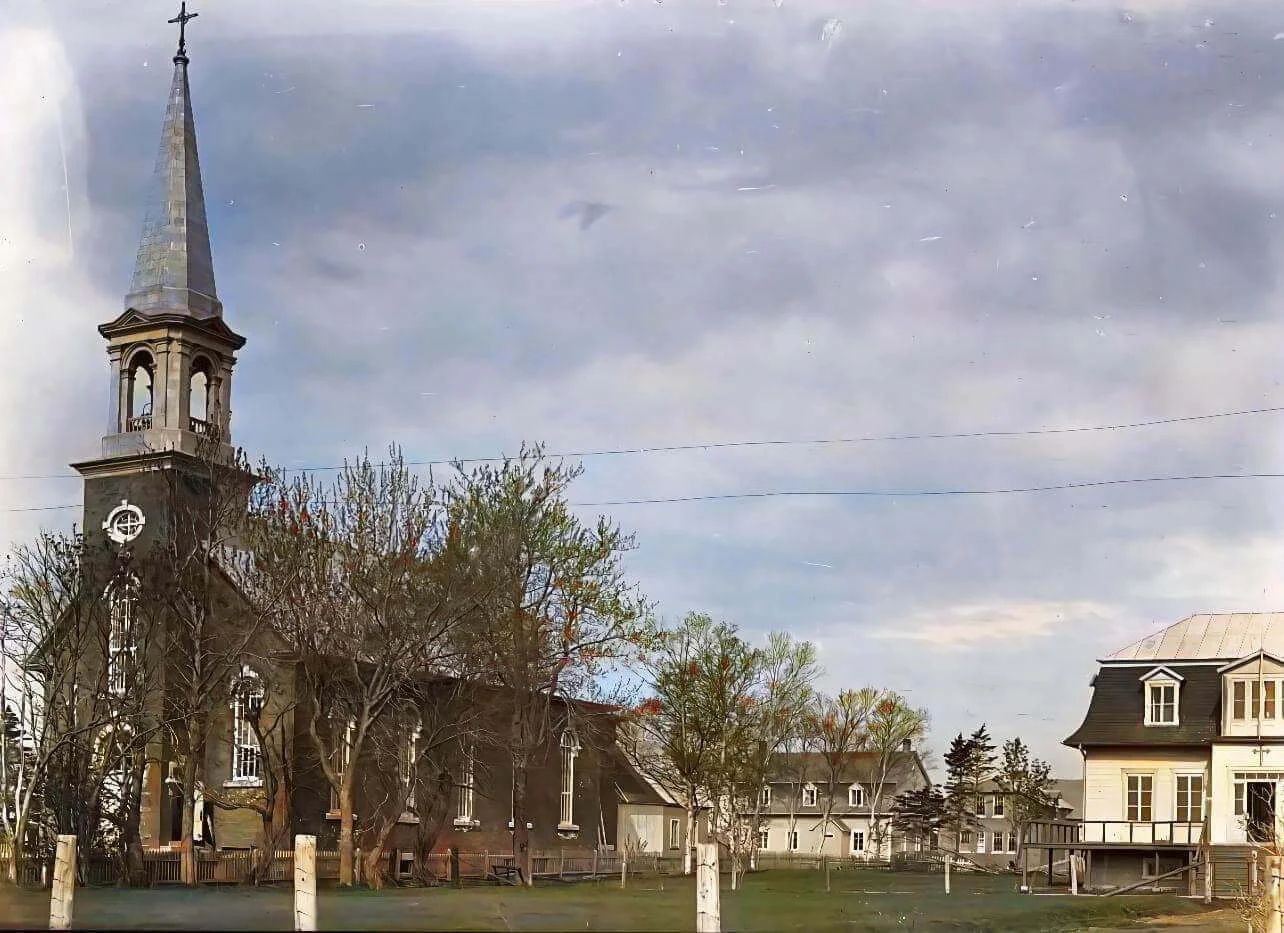
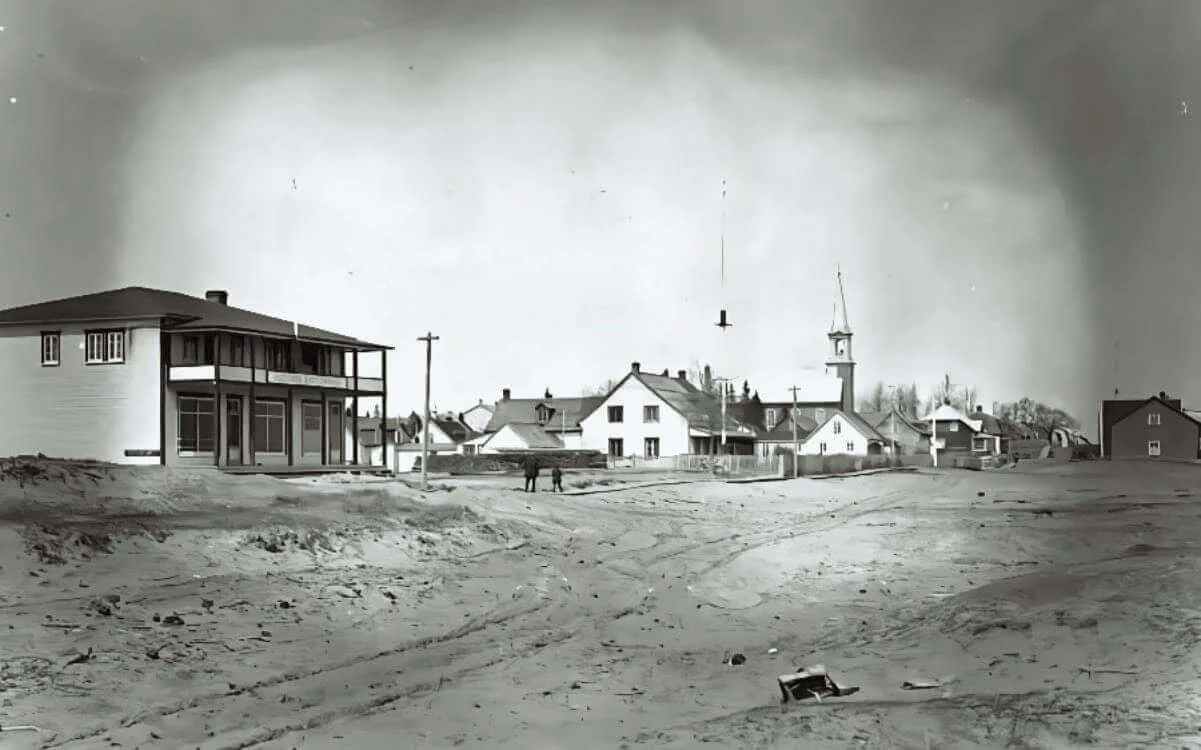
Bersimis church, its steeple, and neighbouring buildings
Bersimis church, circa 1920 ·BAnQ Sept-Îles ↗

Labrie, N.-A.,Quelques souvenirs (1905–1931), pp. 64–68. Edited by Pierre Frenette. Read by Father Jean-Guy Lachance. © Société historique de la Côte-Nord · Reproduced with permission.
02

Pages 69–70

Hunting in Betsiamites

Hunting grounds, conservation practices, and the changes that transformed family life.

Listen · Read by Father Jean-Guy Lachance

Read the text: Hunting in Betsiamites

When I arrived in Betsiamites, the forests inland had been only lightly explored, and could still be called virgin forests. The watersheds of the Betsiamites, Outardes, and Manicouagan rivers were undisputed hunting grounds for the people of Betsiamites…

Read more

Almost no white people hunted in that country. Innu travelling up the Betsiamites River as far as Lake Pipmouagan would encounter people from Pointe-Bleue, who hunted along the Péribonka or Ste-Anne rivers. Those who reached the source of the Manicouagan often met Innu from Hudson Bay.

In those territories, each family had its own hunting grounds, passed down from father to son and respected by everyone’s tacit consent. Each autumn the family returned, and its rights were honoured. A hunter divided his territory into three sections and never hunted in the same one two years in a row, giving the animals time to reproduce and maintain their numbers. When a beaver lodge was found on a lake, the Innu hunter had ways of estimating, fairly accurately, how many animals lived there. They never took them all, always leaving some to breed. Thanks to this thoughtful practice, trapping had continued for centuries while animal populations remained more or less stable.

Later, forestry explorers moved into these territories. Once the region’s wealth became known, unscrupulous adventurers followed the same rivers, some arriving in midsummer before the Innu. They stole traps, took over camps, and often refused to return them to their rightful owners. Worse still, they hunted until the wildlife was depleted.

The Innu often came to tell me of their grievances. Several times, the Indian agent and I petitioned the Department of Indian Affairs and the provincial government. We wanted protection and recognition of Innu rights, which no law guaranteed. We were promised, among other things, that certain territories would be set aside exclusively for them. We understood, however, how difficult such measures would be to put into practice. In the meantime, especially after I left Betsiamites, industry took over the region. Dams and hydroelectric plants were built for the country’s greater good, but to the great detriment of the fur-bearing animals.

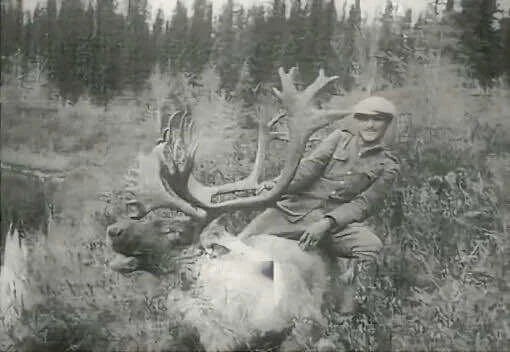
When each family left the village in September, its canoes carried the basic provisions: flour, lard, butter, canned goods, and the like. They relied on hunting and fishing for meat. The rivers and lakes were full of trout and landlocked salmon, which could be frozen when the first hard frosts came. They also ate what they hunted: ducks, hares, partridges, lynx, beavers, and especially caribou when they were fortunate enough to find a herd. At the time I am describing, moose were unknown east of the Saguenay. The first one anyone knew of was seen at Les Escoumins in the summer of 1924. I do not believe white-tailed deer have appeared there yet.

Labrie, N.-A.,Quelques souvenirs (1905–1931), pp. 69–70. Edited by Pierre Frenette. Read by Father Jean-Guy Lachance. © Société historique de la Côte-Nord · Reproduced with permission.
03

Pages 71–74

The fur trade

The fur trade, long expeditions, and the hunters’ skill.

Listen · Read by Father Jean-Guy Lachance

Read the text: The fur trade

Beaver pelts still formed the main source of income for our hunters. Depending on its size, a pelt could sell for twenty-five dollars. Those who travelled as far as the source of the Manicouagan hunted mainly marten; the finest pelts could be worth as much as one hundred dollars…

Read more

One spring, Ignace Picard and his two sons returned with proceeds of nine thousand four hundred dollars, almost entirely from marten pelts.

Mink pelts could fetch as much as forty-five dollars. Black fox fur had become worthless after the fur industry found a dye that could turn red fox fur black. My father had once sold a black fox pelt for eight hundred dollars. Fur farming had not yet driven down the price of silver fox pelts; the finest could fetch two hundred and fifty dollars.

Other, less valuable catches included lynx, muskrat, and ermine. Otters were rare, and their price varied greatly with the quality of their fur. The finest could fetch one hundred dollars.

In those days, if you asked an Innu man, “Did you have a good hunt?” he would often reply, “A po chouk”—“Not much. Four thousand.” What a pity they had not learned to save more! But no one helped them. Their way of life was not suited to saving, either; it would have taken years and a new generation, with intensive training. The days of plenty are now past, and the Innu have to learn to earn a living in the way white people do.

To outsiders, their lives seemed harsh, but to them they were free and beautiful. They knew how to avoid its dangers. I do not remember a single accident in the woods during the seven years I spent with them. That showed how resourceful they were.

Pierre Metzekapo was a “Naskapi,” that is, an Indigenous man from the interior who had settled in Betsiamites. One evening, as he returned by canoe and landed a few hundred paces from his camp, he tried to grab his rifle by the barrel. It discharged and severed his right arm near the shoulder, leaving it attached only by a strip of flesh. Without hesitation, he cut through the remaining tissue with his knife, secured his canoe, gathered his weapons and belongings with his other hand, and made his way to camp. To stop the bleeding, he packed the wound with a handful of gunpowder. It must have been an excellent antiseptic: he healed without returning to the coast, continued hunting, and remained a hunter for the rest of his life. With one arm he was as strong as an ox.

Some of our hunters stood out above all the others, including Ignace Picard and his sons. They travelled far up the Manicouagan, past the great lake and as far as the range known as the White Mountains. There they often met Innu from Hudson Bay and traded fine furs for items such as watches and knives that they had brought for this purpose. Ignace was considered the best hunter on the reserve. He had built himself a good house, spent freely, and, being deeply charitable, gladly gave to anyone in need.

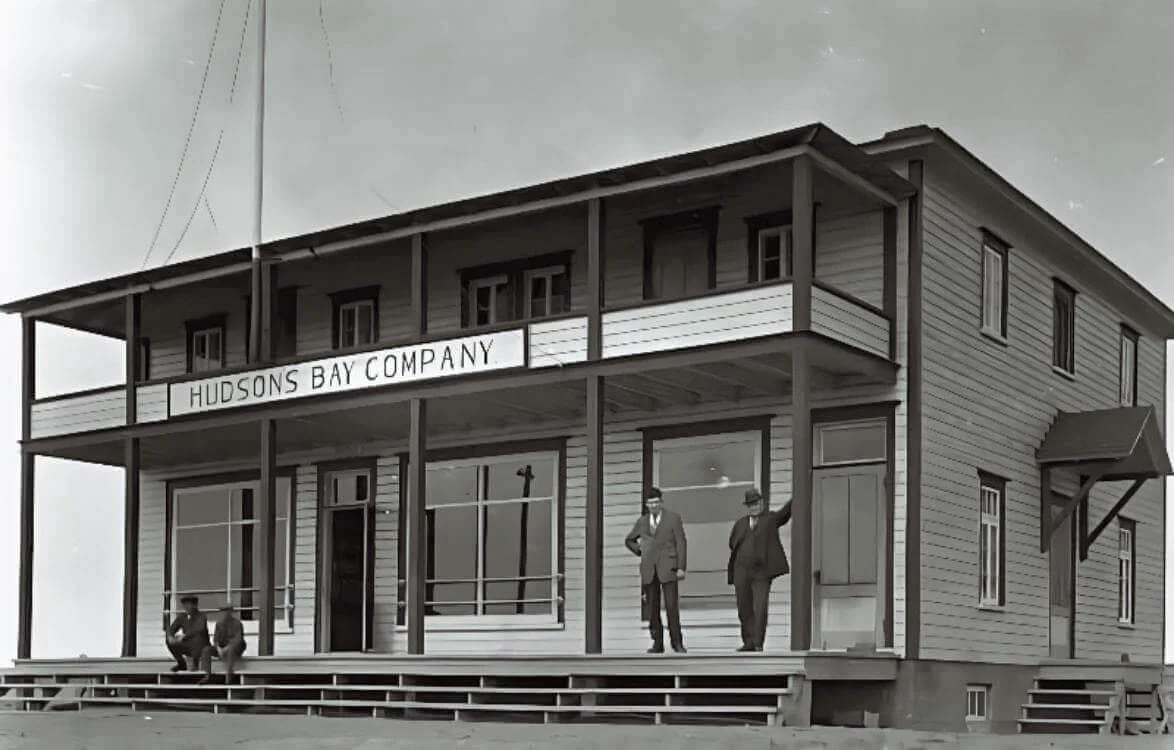
Hudson’s Bay Company building in Bersimis
Hudson Bay Company post at Bersimis, circa 1920 · BAnQ Sept-Îles

Labrie, N.-A.,Quelques souvenirs (1905–1931), pp. 71–74. Edited by Pierre Frenette. Read by Father Jean-Guy Lachance. © Société historique de la Côte-Nord · Reproduced with permission.
04

Pages 74–75

The Royal Canadian Mounted Police

Constable Josaphat Brunet and a turbulent expedition to Îlets Jérémie.

Listen · Read by Father Jean-Guy Lachance

Read the text: The Royal Canadian Mounted Police

The Department of Indian Affairs maintained a permanent Royal Canadian Mounted Police post, or “Mounted Police,” as they were commonly called. We were fortunate to have Josaphat Brunet as the officer in charge. He would later be sent to Paris as head of Interpol…

Read more

Before leaving Betsiamites, he married Miss Mercédès Miller, daughter of the merchant Joseph Miller and his wife. Brunet was as much a gentleman as he was intelligent and courageous.

In June 1928, a handsome white yacht anchored on the west side of the river, where the ferry landing would later be built. It carried a large load of whisky, but the crew had no time to sell it. Brunet and his assistant, Clément, went aboard. The captain and his men were armed and tried to keep the officers from boarding. Brunet jumped onto the deck, and the men attacked him. He drew his revolver and shot the captain in the foot as the man held him by the throat. That was enough. The crew surrendered; the boat and its cargo were seized, and the men were taken prisoner.

He was less fortunate in another adventure. He had been told that a schooner had left a large hidden cache at Îlets Jérémie, under the watch of Mr. Pitre Fortin or his son-in-law, Philippe Huard. One evening, Brunet came to tell me about his predicament. He was looking for a boat to investigate, but no one wanted to get mixed up in such an undertaking.

A few days later, Father Poulin and I were due to leave to visit the outlying communities at Laval. Brunet and Clément came by and asked us to drop them off at Îlets Jérémie on the way. It was almost impossible to refuse. I knew Mr. Fortin so well that I was sure the expedition would be a waste of time.

At seven o’clock we dropped anchor opposite Îlets Jérémie. There was no sign of life around the two houses. Brunet had brought a canvas canoe to go ashore. Father Poulin and I were to continue our journey. There was no wind, but a light swell was coming in from the open water. They had barely settled into the canoe when I saw that neither of them had any experience with it. I had no time to shout, “Get down!” before it capsized. Clément swam to us, and I caught him by the gunwale. Brunet clung to the canoe, rolling with each wave, already too far away for us to reach him with a boat hook. We had to raise anchor and bring the boat closer. Once we caught him, we hauled him aboard like his companion. Now we had to get these two men—shivering and barely able to help themselves—onto the boat. It was late October.

Once they were aboard, there was only one thing to do: take them to a house to warm up. No one on shore had noticed anything, but the family welcomed us with great kindness and asked no questions about the excuse we had to invent. After we had put the two men into good beds, Mr. Fortin asked me, “If I give them a good ‘ponce’ (a hot toddy), will they do anything to me?” “Give them a very good one, and I’ll guarantee you won’t be in trouble.” Our two constables fell asleep in the warmth after an excellent St-Pierre. When he woke, Brunet admitted, “After such warm hospitality, it would be rotten to bother them. We’ll just thank them and continue the trip with you as tourists.” Mr. Fortin had some St-Pierre whisky, as many people kept for their own use. Was there a hidden cache there? We never found out.

Labrie, N.-A.,Quelques souvenirs (1905–1931), pp. 74–75. Edited by Pierre Frenette. Read by Father Jean-Guy Lachance. © Société historique de la Côte-Nord · Reproduced with permission.
05

Page 76

The Indian Affairs inspector

An annual inspector whose stay in Betsiamites prompted a complaint to the Department.

Listen · Read by Father Jean-Guy Lachance

Read the text: The Indian Affairs inspector

During the six years I spent in Betsiamites, the Department of Indian Affairs always sent the same inspector, a Mr. Bury. He arrived around August 15 to attend the Innu celebration…

Read more

On that occasion he organized a large bonfire on the shore and danced the “Macouchame” with everyone. That was all very well, but his stay in Betsiamites was more like a vacation, spent mostly having fun and drinking.

He was hardly a model of temperance for the Innu. At last, the Indian agent and I went to Ottawa to file a complaint. We were promised that another inspector would be sent, though that happened after I had left.

Houses and buildings in Bersimis in the early 20th century
Bersimis, circa 1920 ·BAnQ Sept-Îles ↗

Labrie, N.-A.,Quelques souvenirs (1905–1931), p. 76. Edited by Pierre Frenette. Read by Father Jean-Guy Lachance. © Société historique de la Côte-Nord · Reproduced with permission.
06

Pages 64–68

The farm

The mission farm supplied milk to families in the village.

Listen · Read by Father Jean-Guy Lachance

Read the text: The farm

The mission priests maintained a large farm with several cows and two horses. This allowed them to supply milk to families in the village. Two men looked after the farm: Joseph Blouin, the grandson of our housekeeper, Mrs. Norbert Lebel…

Read more

He had married a Miss Hémond from Portneuf. In my second year, I had a good-sized house built for him.

His assistant was Edmond Doucet, Father Doucet’s brother. In 1925 or 1926, Edmond would marry a teacher, Miss Edwidge Blaney of Rivière-au-Tonnerre.

Labrie, N.-A.,Quelques souvenirs (1905–1931), pp. 64–68. Edited by Pierre Frenette. Read by Father Jean-Guy Lachance. © Société historique de la Côte-Nord · Reproduced with permission.

07

Page 79

Education

The village school, the Sisters of the Good Counsel, and access to education.

Listen · Read by Father Jean-Guy Lachance

Read the text: Education

In 1923, the Sisters of the Good Counsel of Chicoutimi had already been established in the village for many years. In fact, it was Father Arnaud who had brought them there. They taught Innu and white children in a house Father Arnaud had built for that purpose…

Read more

As I mentioned earlier, this school year ran from October through September of the following year. These dates were dictated by circumstances I have already described.

Early in 1925, the Department began building a larger four-classroom school, with living quarters and a chapel for the sisters. This was already progress. The old school was converted into a dispensary and a home for elderly Innu, under the direction of Mrs. Joseph Murphy.

Conditions for the Innu were beginning to change. It was expected that they would eventually have to adapt to a different way of life. Several young women—including Yvonne and Jeanne Bacon and Madeleine Roc—had already completed their studies with distinction at the boarding school in Rimouski. After I left, an even larger and finer school would be built.

Then, in 1950, when Indian Affairs built a large residential school at Maliotenam, it could not keep pace with the Innu’s growing demand for education. I sincerely hope that all my fellow citizens will show these people the same friendship I feel for them, and help them attain the education they rightfully seek.

Labrie, N.-A.,Quelques souvenirs (1905–1931), p. 79. Edited by Pierre Frenette. Read by Father Jean-Guy Lachance. © Société historique de la Côte-Nord · Reproduced with permission.

08

Pages 80–82

The Sandbank at Betsiamites

The Bersimis Mill, the Miller families, and winter mail along the Coast.

Listen · Read by Father Jean-Guy Lachance

Read the text: The Sandbank at Betsiamites

Across from the Innu village, the Girouard Company of Sherbrooke had once built a sawmill, and a village had grown up around it, known as the Bersimis Mill. It was more often called “the Sandbank,” as it stood on a sandbar formed over many centuries…

Read more

It had once enjoyed a measure of prosperity and had a resident priest; the last was Father Brézel.

By 1924 only three families remained: David and Mrs. Miller, who lived with their son Oscar and his wife, Alice Martel of Manicouagan; Frank Miller, who had married Miss [Victoria] Thibeault; and Alexandre Miller, who had married Miss [Blanche] Imbeault of Portneuf. In 1925, a young man from Métis, Georges Deschènes, who had come to work on the church construction, would marry Frank’s daughter Alice and settle near his father-in-law.

The other houses and buildings of the Girouard Company had fallen into ruins.

In my view, David Miller was one of the North Shore figures who deserved special attention. He and his brother Xavier were sons of a Scotsman [Samuel Miller] who had come to the Coast, probably in the service of the Hudson’s Bay Company. David married Miss [Edmire] Arseneault from the Betsiamites mill. While still very young, he joined the postal service, carrying mail in winter from Betsiamites to Pointe-des-Monts, where another courier took it on to Sept-Îles. There were no roads or trails then. David made two or three trips each winter, travelling on snowshoes alone. He set out from Betsiamites with a seventy-five-pound mailbag and a few provisions on his back.

How far he travelled in a day depended largely on the condition of the snow. Homes stood many miles apart, and evening often came before he reached an inhabited place. Then Mr. Miller would choose a suitable spot—a rock ledge or a stand of fir trees offering shelter from the wind. He cut a few dry logs and built a good fire. With hot tea and a frugal meal, he slept beneath the open sky beside its warmth. At daybreak, after breakfast and another steaming cup of tea, he shouldered his snowshoes and mailbag again. Such a hard life seems inconceivable in our modern comfort. Mr. Miller was not the only one to live it. These hardy pioneers helped build our society in one way or another, and deserve our deepest admiration and gratitude.

Those old-timers all repeated the same saying: “Hardship doesn’t kill.” Mr. Miller was living proof. He lived to the age of eighty, a handsome white-bearded elder, gentle yet energetic and agile to the end.

He kept up this postal service for many years. By the time I arrived in Betsiamites, however, conditions had improved. There were more homes, closer together, and the mail had grown heavier and bulkier. Mr. Miller had to enlist his sons’ help. Mail was then carried by horse as far as Pointe-Lebel. From there, it travelled to Pointe-des-Monts in wooden canoes reinforced with sheet metal to withstand the ice. When the sea was clear, they rowed. If they encountered ice, they hauled the canoes onto it and dragged them with their cargo, taking care not to break through.

Later, Hector and Jean, the sailors from Pointe-aux-Outardes, took over the contract. They added motors to their canoes. When they did not have to drag the boats to keep warm, their only way to warm up was to swing their arms.

Progress gradually reached the region. I believe it was in 1926 or 1927 that Dr. Cuisinier [a French aviator] and Roméo Vachon inaugurated the first winter airmail service. At first, they carried only first-class mail, dropping it from the air as close as possible to the post offices. The service quickly expanded, began accepting passengers, and completely replaced overland mail delivery.

Dr. Cuisinier’s first plane was very small, and I do not know its name. It was soon replaced by [de Havilland Dragons], Fairchilds, and, [around 1949], Beavers [and eventually de Havilland biplanes], before the DC-3s and the aircraft we have today.

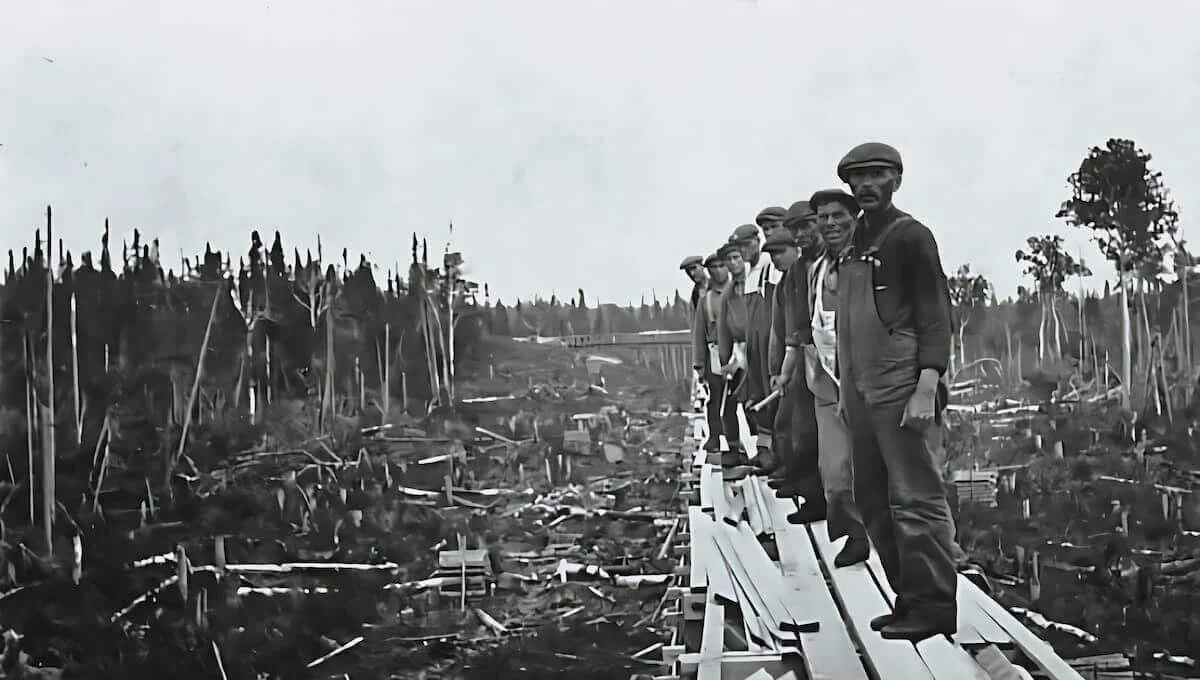
Workers standing on a long timber at a forestry site
Bersimis construction site ·BAnQ Sept-Îles ↗

Labrie, N.-A.,Quelques souvenirs (1905–1931), pp. 80–82. Edited by Pierre Frenette. Read by Father Jean-Guy Lachance. © Société historique de la Côte-Nord · Reproduced with permission.

09

Pages 82–83

Pastoral visits to the outlying communities

Pastoral rounds, visits to the sick, and the village doctor.

Listen · Read by Father Jean-Guy Lachance

Read the text: Pastoral visits to the outlying communities

Father Doucet and I took turns providing religious services in the other communities of our parish. Each June, Father Doucet left to visit the other Innu reserves along the Coast and did not return until mid-August…

Read more

I then had to ask a few Eudists who taught at the college to help. They were glad to come, treating it like a pleasant holiday.

The pastor and curate then took turns travelling east or west. We always went as far as Portneuf and St-Paul-du-Nord, where the pastors, Fathers Bouchard and Dufour, welcomed us warmly. Apart from Pointe-aux-Outardes, we had no chapels. We had to celebrate Mass in people’s homes, or in the schools once we had built them.

Along with our regular trips, we were often called to visit the sick. On my first Christmas, immediately after midnight Mass, I had to leave for Pointe-aux-Outardes to give the last rites to one of Alexandre Tremblay’s sons. Fortunately, he survived his pneumonia.

There were no medical services in these communities. Midwives attended births. Among them were Mrs. Cyrisse Desbiens in Ragueneau and Mrs. Josué Côté in Pointe-aux-Outardes. They were remarkable women, rich in faith if not in medical knowledge, and they always brought a crucifix with them. God visibly came to their aid.

In 1925, the Brown Corporation hired a young doctor, Dr. Johnston, to care for its workers in Papinachois. He was a Protestant, but I have rarely met anyone more considerate or more deeply charitable. He often came to ask me how best to treat his Catholic patients. He gladly accompanied me on visits to the sick, and if he was called as far as Ragueneau, he charged no more than five dollars. The people felt awkward about this and asked me to tell him they would gladly pay a higher fee. His reply is one I will never forget: “Father, my salary is enough for me. These people are not wealthy. As a priest, you charge nothing when you visit your sick. I have always regarded medicine as a vocation, a ministry that supports yours. Tell your people I want nothing more.”

Labrie, N.-A.,Quelques souvenirs (1905–1931), pp. 82–83. Edited by Pierre Frenette. Read by Father Jean-Guy Lachance. © Société historique de la Côte-Nord · Reproduced with permission.

10

Pages 83–85

Calls to the sick

Two emergencies at Îlets Jérémie and the families who lived far from medical care.

Listen · Read by Father Jean-Guy Lachance

Read the text: Calls to the sick

In December 1926, I had just finished Mass when Martin Hickey arrived from Îlets Jérémie, deeply distraught. His eldest daughter, Hethay, was seriously ill. (Martin Hickey had bought the house of his father-in-law, St-Pierre)…

Read more

It was bitterly cold and stormy that day. He had travelled for part of the night and left his horse at the Sandbank. We had to cross the river by canoe despite the storm, then set out again along impossible roads.

Night had completely fallen by the time we arrived, and the poor girl had been dead for several hours. Imagine a family’s anguish in that lonely place. The young woman lay on her bed, waiting for hours to be buried. The Fortin family, three miles away, knew nothing. Mrs. Hickey wanted us to fetch Mrs. Fortin.

I had an old lantern lit and set off along the shore, skirting the woods. The wind sometimes blew it out, and I had to go into the woods to relight it. The Fortins had seen its flickering light and thought it was a will-o’-the-wisp. They were startled to see me come in and dismayed by the news.

The tide was rising, and a channel had opened between the ice floes. We put Mrs. Fortin in a small boat and, guided by her son, returned to the grieving family.

On another occasion, I was no more successful…

This was again at Îlets Jérémie, this time at the Fortins’ home. I had been called there along with the doctor for Mr. Fortin’s son, Héliodore. The young man had been married for more than a year to Alexina Gagnon, Mrs. Norbert Lebel’s niece, who helped her aunt at the rectory. The doctor found nothing serious, prescribed some remedies, and we returned to Betsiamites. Eight days later, I was called back for the same patient, this time with Dr. Eager from Chute-aux-Outardes. His condition had worsened considerably, and the doctor diagnosed peritonitis. The nearest hospital was in Rimouski, and no boat would be available until the following evening. The patient had a very high fever and was in great pain. He would not survive until the boat came if we left him as he was. We had to operate, at least to insert a drain.

What could we do? There was no electric light. It was night, and the doctor needed good lighting. The family had a Coleman lantern, but it would not work. I set about repairing it and managed to get it going.

I had to improvise as an anaesthetist—not to put the patient fully to sleep, but to make him unconscious enough to spare him too much pain. We sterilized the instruments, and the doctor performed the operation. It brought considerable relief, and the patient was able to rest while we waited to take him to Rimouski. Early the next morning, the doctor returned to Betsiamites and asked the captain of the V. M. Manicouagan to make a detour to Îlets Jérémie and take the patient aboard. At seven the next evening, I reached the hospital with him. The hospital doctors praised Dr. Eager for taking that initiative, but, alas, it was too late. Our young patient died during the night.

Fortunately, such serious cases were rare. More often we were called out for minor problems, a toothache or something similar. Still, we were always glad to respond at the first call, moved by these good people’s faith and trust in the priest. If Father Doucet and I were able to encourage them a little in their hard lives, we do not regret a single interruption. On the contrary, we feel that we shared in the work of pioneers and builders of this country. No one was perfect, but societies are built by imperfect people, and Providence continues its work through imperfect instruments. These men and women remain admirable and worthy of esteem. As the years pass, we take ever greater pride in having shared in their humble hopes and in God’s work among them.

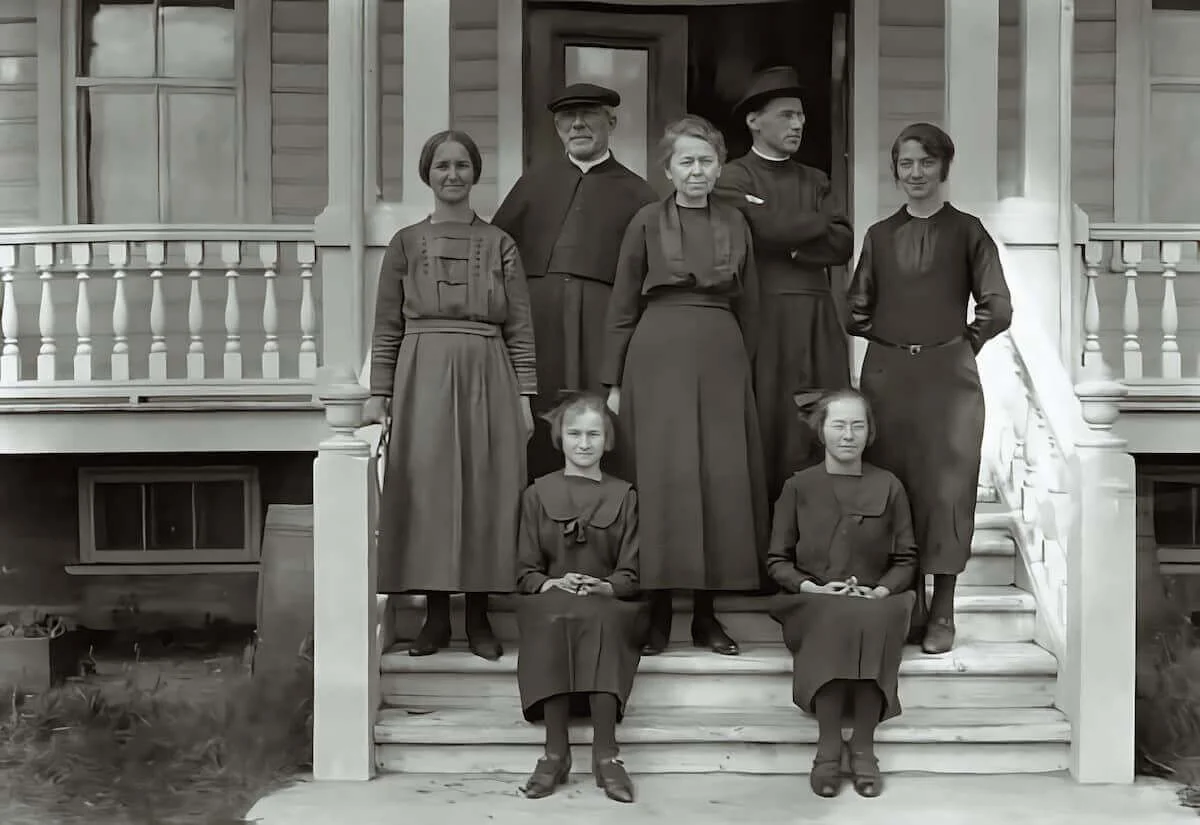
Bishop Labrie, Father Ledoré, and several women and girls outside a house
Father Ledoré, Bishop Labrie, Catherine Martin, Odile Cormier, Mrs. Noël, Yvonne Martin, and Lucienne Martin · BAnQ Sept-Îles

Labrie, N.-A.,Quelques souvenirs (1905–1931), pp. 83–85. Edited by Pierre Frenette. Read by Father Jean-Guy Lachance. © Société historique de la Côte-Nord · Reproduced with permission.

Further reading

Sources and resources

Historical photographs: BAnQ Sept-Îles. Catalogue details are linked below images where available.